The neighbourhood
Corso Vittorio Emanuele II
The long street where the show stands: when it was named, why it cuts through the old centre, and the churches and ruins you pass along it.
Book the history show ↗Quick answer
Corso Vittorio Emanuele II is a long, almost straight street from Piazza del Gesù to Piazza Pasquale Paoli. It was designed to link the old centre with new districts across the Tiber, and it cut through old neighbourhoods. The history show is at number 203. Along it are Sant'Andrea della Valle, Chiesa Nuova and the crossing at Largo di Torre Argentina.
A street cut through the old city
Italian Wikipedia says the corso was designed as a quick link between the administrative centre near Via del Corso and the new middle-class districts rising across the Tiber at Prati di Castello. Its nearly straight line cut through the old quarters in the river bend, and many historic palaces were demolished, among them Palazzo Sforza-Cesarini. It is a modern street laid over a medieval and Renaissance one.
A name that changed
The Rome city council approved the name Corso Vittorio Emanuele on 19 April 1886, honouring Italy's first king. In 1944, after the royal-family street names were abolished, the Italian wording became Corso Vittorio Emanuele II, and a 2015 council decision changed the spelling again. You will see all of them on maps and signs. The number matters more than the name, because the corso is long.
Churches on the way
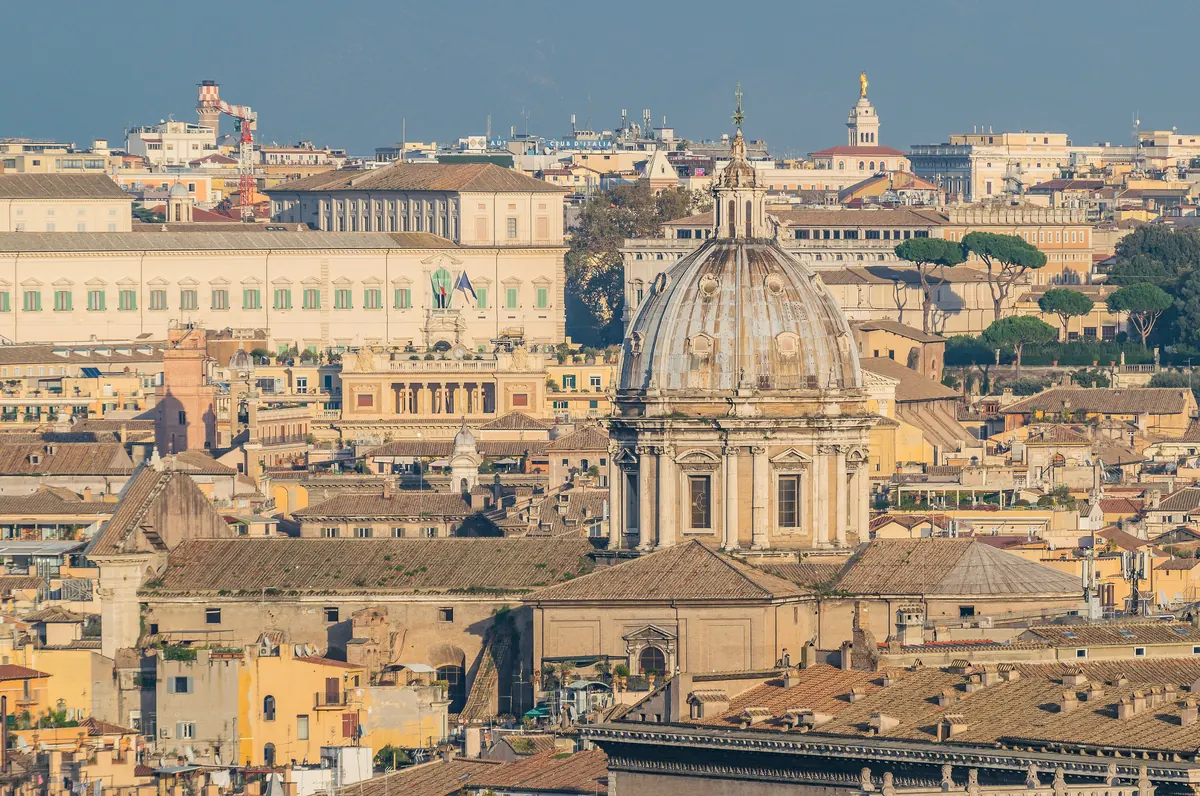
Sant'Andrea della Valle faces the corso on Piazza Vidoni. Wikipedia says work began around 1590, that the Baroque facade was added between 1655 and 1663, and that its dome was for a long time the third largest in Rome, after St Peter's and the Pantheon. The first act of Puccini's Tosca is set in it. Further along, Chiesa Nuova, formally Santa Maria in Vallicella, was consecrated in 1599 and holds an altarpiece painted by Rubens between 1606 and 1608.
A Renaissance palace
Wikipedia calls the Palazzo della Cancelleria the earliest Renaissance palace in Rome. It stands between the corso and Campo de' Fiori and was built from 1489 to 1513 for Cardinal Raffaele Riario. The same article says its travertine came from the nearby ruins of the Theatre of Pompey, and that its courtyard has 44 granite columns from that theatre. Wikipedia adds that it houses institutions of justice of the Roman Curia and is extraterritorial property of the Holy See.
Largo di Torre Argentina
The corso crosses Largo di Torre Argentina, an open square with four Roman Republican temples and the remains of Pompey's Theatre. Wikipedia says Julius Caesar was killed in the Curia of Pompey and that the spot where he is believed to have died lies within the square. Demolition work in 1927 uncovered a colossal marble head and arms and revealed the sacred area. It makes an easy stop between the corso and the next square.
The squares beside it
Piazza Navona sits on the site of the Stadium of Domitian and keeps its elongated oval shape; Bernini's Fountain of the Four Rivers is from 1651. Just south of it is Campo de' Fiori, the square where a daily market has run since 1869 and where Giordano Bruno was burned in 1600. Both lie in the same part of the old centre as the show, and both are worth the detour after the film.
Where the corso ends
The corso ends at the Ponte Vittorio Emanuele II, which Wikipedia says was inaugurated in 1911 and which links the historic centre with the Borgo quarter and Vatican City, extending the corso's line. Its three arches span 108 metres, and winged bronze Victories stand at both ends. Walking the whole corso from Piazza del Gesù to the bridge takes in churches, palaces and squares in one long line.
Why it matters for a visit
The show is in a former cinema on this street, so you will be sightseeing in the old centre rather than at one monument. That helps with planning: you can see the show, then walk through churches and squares without a long transfer. The corso is a long straight road, so check which end of it your hotel or station is closer to, and use the street number to find the door.
Frequently asked questions
Where does the corso run?
Italian Wikipedia says from Piazza del Gesù to Piazza Pasquale Paoli, at the start of Ponte Vittorio Emanuele II.
Why do the street's names differ?
It was named Corso Vittorio Emanuele in 1886, renamed Corso Vittorio Emanuele II in 1944, and respelled in 2015, so maps use all three.
Sources